
Select name
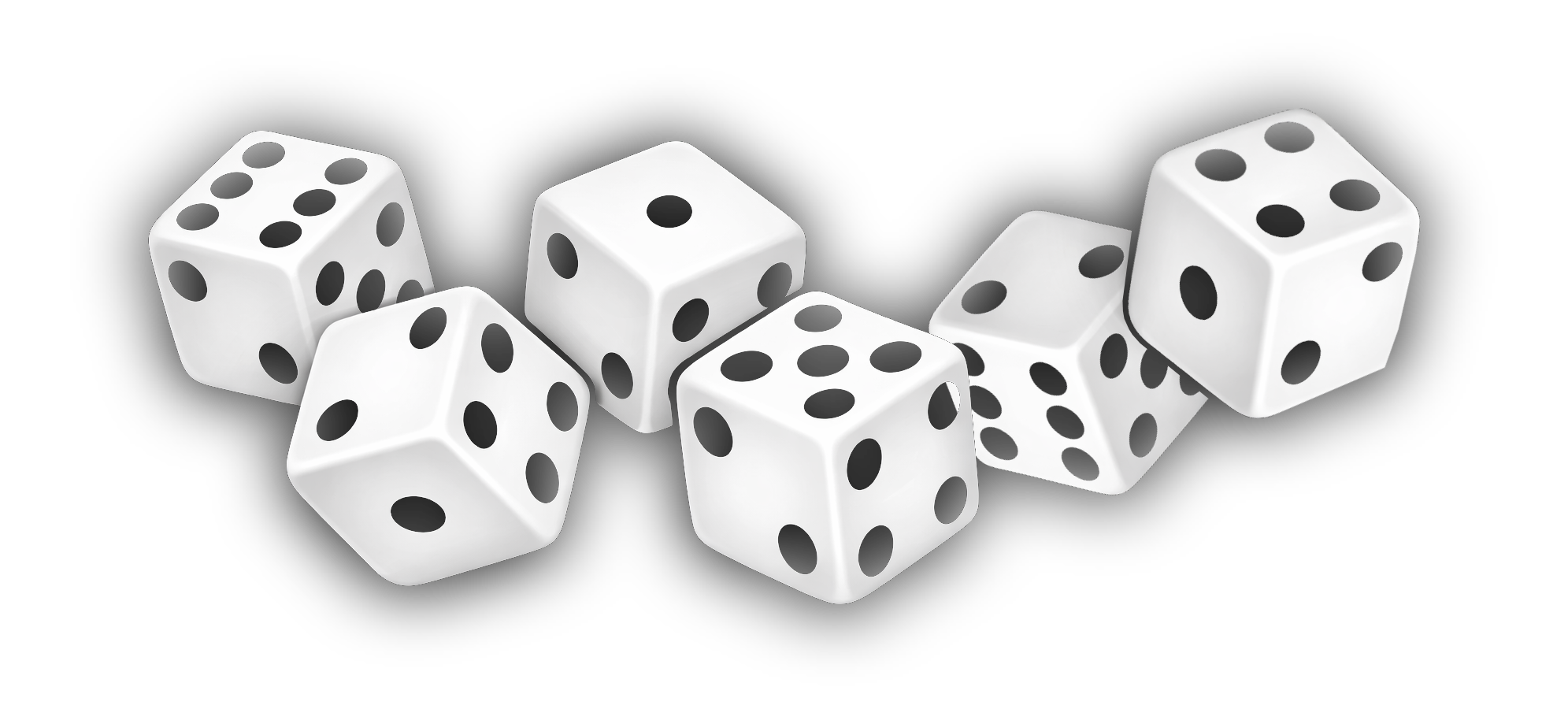
1. The game is played in turns, usually with 6 dice. The goal is to score as many points as possible and reach or exceed a target score (agree on it in advance, often 10,000).
2. Order: Roll one die (or all dice) — the higher roll goes first. Then players alternate turns.
3. On your turn, you roll all dice. From the roll, you must choose at least one scoring combination and set those dice aside. For your next throw, you may only keep (set aside) dice that score (i.e., dice that create value).
4. With the remaining dice, you can either:
5. If you roll and there are no scoring combinations, it's a Farkle: you lose all points from the current turn and your turn ends.
6. If, during a single turn, you set aside scoring dice in a way that uses all 6 dice, you have "hot dice": you pick up all 6 dice and may roll again in the same turn (and continue risking/banking).
7. The game ends when someone reaches or exceeds the target score.
8. However, once a player reaches or exceeds the target score (e.g., 10,000), the game does not end immediately.
9. The rest of the round is completed: only the players who come after that player in turn order get one final turn and a chance to beat them.
10. Players who already took their turn earlier in that round do not get another turn (they've already used their chance).
11. After those final turns are played, the player with the highest score wins.
Previously thrown dice can be extended.
In each turn, you may add newly rolled dice to combinations you already built earlier in the same turn. For example, if you already have 6, 6, 6 (600 points) and then roll 4, 3, 6, you may add that new 6 to the existing set. This gives you 6, 6, 6, 6 (1,200 points), and you may continue rolling.
Two triplets are scored as their combined value.
In Royal Farkle, two triplets (for example 3-3-3 and 5-5-5) are worth the sum of both triplets (300 + 500 = 800 points). In many other Farkle rulesets, two triplets are instead worth 2,500 points.
The final round continues after the target score is reached.
In Royal Farkle, the game does not end immediately when a player reaches or exceeds the target score (for example 10,000 points). Instead, the round is completed and remaining players still have a chance to win.
Farkle (often also spelled Farkel) is a classic folk push-your-luck dice gambling game that has been passed down orally for generations, which is why it has many names and rules variants (e.g., Ten Thousand / Dix Mille, Zilch, Zonk, Squelch, Greed, and others). That "family game" tradition is exactly why the scoring and small turn details so often differ from one group to another. Farkle is well known for its wide variety of scoring systems and rule interpretations. Some rulesets even assign points to a "Farkle" itself, meaning a first roll with no scoring combination at all, sometimes awarding as much as 1,500 points. In the more common expanded variant, however, the term keeps its stricter meaning: if a player fails to roll any scoring combination on the first throw of their turn, the entire turn is lost for 0 points, and that non-scoring result is called a Farkle. In other versions of the game, additional combinations may also score, such as four of a kind with a pair.
A Gettysburg College academic paper by Todd W. Neller and a co-author analyzes Farkle at a deeper, more mathematical level, deriving optimal strategy for two-player play under a specific ruleset. The study also notes a fairness issue: because the first player has a slight advantage, the authors suggest compensating the second player—in their model, by giving them +200 points at the start.
There's the cultural footprint: Farkle has made it into video games as a gambling mini-game — for example, Kingdom Come: Deliverance (and the follow-up Kingdom Come: Deliverance 2) uses a related "dice" variant with different (even "enhanced") dice, which has made Farkle a pop-culture-familiar concept for some players beyond family play.
Equipment and instructions to play Farkle dating to the 1700s have been found at Fort Chartres, Illinois. According to the official Pocket Farkel game documents, scholars believe the game arrived on French sailing ships in the 1600s and has been passed down in families ever since. The game has also been claimed to originate from Iceland through the purported English nobleman Sir Albert Farkle, who is said to have first played it there in the 1300s or 1400s, but this is not considered credible. Another claim is that the game originates in Texas, based on the fact that farkleberries grow there and the game could purportedly be played with dried farkleberries. However, as a folk game passed down through families, the game has a number of names: even if the name "Farkle" did come from farkleberries, as one of many names of the game, it could simply have been acquired as the game passed through Texas.
Six ones is the perfect throw in Farkle: the highest single-roll score and the ultimate achievement in the game. With odds of only 0.002%, ~1 in 46,656 rolls, it is a legendary moment earned by those who keep rolling and never give up.
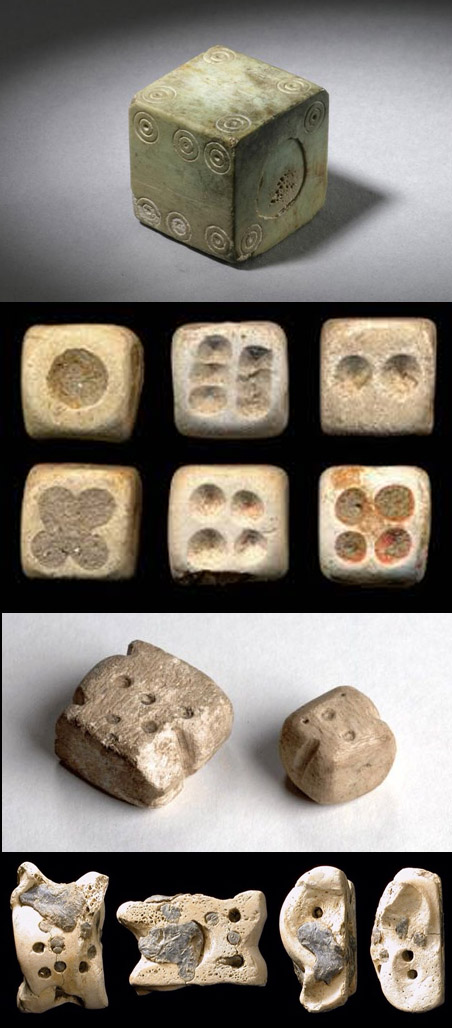
The oldest known dice, dating back over 5,000 years (roughly 3000–2500 BCE), were discovered in the Middle East, specifically in southeastern Turkey, Iran's Burnt City, and Iraq. These early, often terracotta or bone, gaming pieces typically originated as "knucklebones" used for divination or games of chance.
App version 1.7.1
Šest jedniček je ve Farkle dokonalý hod: nejvyšší možné skóre v jediném hodu a největší úspěch ve hře. S pravděpodobností pouhých 0,002 %, tedy přibližně 1 z 46 656 hodů, jde o legendární okamžik, kterého dosáhnou ti, kteří házejí dál a nikdy se nevzdávají.
Hra se hraje na tahy, obvykle se 6 kostkami. Cílem je získat co nejvíce bodů a dosáhnout nebo překročit cílové skóre (dohodne se předem, často 10 000).
Pořadí: Každý hodí jednou kostkou (nebo všemi kostkami) — vyšší hod začíná. Poté se hráči střídají.
Ve svém tahu házíš všemi kostkami. Z hodu si musíš vybrat alespoň jednu bodující kombinaci a tyto kostky odložit stranou. Pro další hod si můžeš ponechat (odložit) pouze kostky, které bodují, tedy kostky tvořící hodnotu.
Se zbývajícími kostkami můžeš buď:
Pokud hodíš a nepadne žádná bodující kombinace, je to Farkle: ztratíš všechny body z aktuálního tahu a tvůj tah končí.
Pokud během jednoho tahu odložíš bodující kostky tak, že využiješ všech 6 kostek, máš „hot dice“: vezmeš si všech 6 kostek zpět a můžeš ve stejném tahu házet znovu (a dál riskovat nebo ukládat body).
Hra končí, když někdo dosáhne nebo překročí cílové skóre.
Jakmile však některý hráč dosáhne nebo překročí cílové skóre (např. 10 000), hra nekončí okamžitě.
Zbytek kola se dohraje: pouze hráči, kteří jsou v pořadí na tahu po tomto hráči, dostanou ještě jeden poslední tah a šanci ho překonat.
Hráči, kteří už svůj tah v daném kole odehráli dříve, další tah nedostanou (svou šanci už využili).
Po odehrání těchto posledních tahů vyhrává hráč s nejvyšším celkovým skóre.
Dříve hozené kostky lze rozšířit
V každém tahu můžeš nově hozené kostky přidávat ke kombinacím, které jsi už dříve v tom samém tahu vytvořil. Například pokud už máš 6, 6, 6 (600 bodů) a potom hodíš 4, 3, 6, můžeš novou 6 přidat k existující kombinaci. Tím získáš 6, 6, 6, 6 (1 200 bodů) a můžeš pokračovat v házení.
Dvě trojice se počítají jako jejich součet
V Royal Farkle mají dvě trojice (například 3-3-3 a 5-5-5) hodnotu součtu obou trojic (300 + 500 = 800 bodů). V mnoha jiných variantách Farkle mají dvě trojice místo toho hodnotu 2 500 bodů.
Závěrečné kolo pokračuje i po dosažení cílového skóre
V Royal Farkle hra nekončí okamžitě, když některý hráč dosáhne nebo překročí cílové skóre (například 10 000 bodů). Místo toho se aktuální kolo dohraje a zbývající hráči mají stále šanci vyhrát.
Farkle (často také psáno Farkel) je klasická lidová kostková hra typu push-your-luck, tedy hra založená na riskování, která se po generace předávala ústně. Právě proto má mnoho názvů a variant pravidel (např. Ten Thousand / Dix Mille, Zilch, Zonk, Squelch, Greed a další). Tato tradice „rodinné hry“ přesně vysvětluje, proč se bodování a drobné detaily tahů tak často liší skupinu od skupiny. Farkle je známé svou širokou škálou bodovacích systémů a výkladů pravidel. Některé varianty pravidel dokonce přidělují body i za samotný „Farkle“, tedy za první hod bez jakékoli bodující kombinace, někdy až 1 500 bodů. V běžnější rozšířené variantě však tento pojem zůstává přísnější: pokud hráč při prvním hodu svého tahu nehodí žádnou bodující kombinaci, celý tah je ztracen za 0 bodů a tento nebodující výsledek se nazývá Farkle. V jiných verzích hry mohou být bodovány i další kombinace, například čtyři stejné kostky a jeden pár.
Odborná studie z Gettysburg College od Todda W. Nellera a spoluautora analyzuje Farkle na hlubší, matematické úrovni a odvozuje optimální strategii pro hru dvou hráčů podle konkrétní sady pravidel. Studie také upozorňuje na problém férovosti: protože první hráč má mírnou výhodu, autoři navrhují kompenzovat druhého hráče — ve svém modelu tím, že začne s bonusem +200 bodů.
Je tu i kulturní přesah: Farkle se dostalo i do videoher jako hazardní mini-hra — například Kingdom Come: Deliverance (a pokračování Kingdom Come: Deliverance 2) používá příbuznou variantu „kostek“ s různými, někdy i „vylepšenými“ kostkami. Díky tomu se Farkle stalo pro některé hráče známým pojmem i mimo rodinné hraní.
Vybavení a pokyny ke hraní Farkle pocházející z 18. století byly nalezeny ve Fort Chartres v Illinois. Podle oficiálních materiálů hry Pocket Farkel se odborníci domnívají, že hra připlula na francouzských plachetnicích už v 17. století a od té doby se předává v rodinách. Objevilo se také tvrzení, že hra pochází z Islandu prostřednictvím údajného anglického šlechtice sira Alberta Farkla, který ji tam měl poprvé hrát ve 14. nebo 15. století, ale toto tvrzení není považováno za důvěryhodné. Jiná teorie tvrdí, že hra pochází z Texasu, protože tam rostou farkleberries a hra se údajně mohla hrát se sušenými plody těchto rostlin. Jelikož jde ale o lidovou hru předávanou v rodinách, existuje mnoho jejích názvů: i kdyby název „Farkle“ skutečně pocházel od farkleberries, jako jeden z mnoha názvů mohl být jednoduše převzat během šíření hry přes Texas.
Nejstarší známé kostky, staré více než 5 000 let (přibližně 3000–2500 př. n. l.), byly objeveny na Blízkém východě, konkrétně v jihovýchodním Turecku, v íránském Burnt City a v Iráku. Tyto rané herní předměty, často z terakoty nebo kostí, obvykle vznikly z takzvaných „kloubních kostí“, které se používaly k věštění nebo hrám náhody.
App version 1.7.1
Sechs Einser sind der perfekte Wurf in Farkle: die höchste Punktzahl, die man mit einem einzigen Wurf erzielen kann, und die ultimative Leistung im Spiel. Bei einer Wahrscheinlichkeit von nur 0,002 %, also etwa 1 zu 46.656 Würfen, ist es ein legendärer Moment, den sich jene verdienen, die immer weiterwürfeln und niemals aufgeben.
Das Spiel wird reihum gespielt, normalerweise mit 6 Würfeln. Ziel ist es, so viele Punkte wie möglich zu erzielen und eine Zielpunktzahl zu erreichen oder zu überschreiten (vorher festlegen, oft 10.000).
Reihenfolge: Jeder wirft einen Würfel (oder alle Würfel) — der höchste Wurf beginnt. Danach wechseln sich die Spieler ab.
In deinem Zug würfelst du mit allen Würfeln. Aus dem Wurf musst du mindestens eine wertende Kombination auswählen und diese Würfel beiseitelegen. Für den nächsten Wurf darfst du nur Würfel behalten (beiseitelegen), die Punkte bringen, also Würfel, die einen Wert bilden.
Mit den verbleibenden Würfeln kannst du entweder:
Wenn du würfelst und keine wertende Kombination erscheint, ist das ein Farkle: Du verlierst alle Punkte aus diesem Zug und dein Zug endet.
Wenn du innerhalb eines einzigen Zuges wertende Würfel so beiseitelegst, dass alle 6 Würfel verbraucht sind, hast du „heiße Würfel“: Du nimmst alle 6 Würfel wieder auf und darfst im selben Zug erneut würfeln (und weiter riskieren oder sichern).
Das Spiel endet, wenn jemand die Zielpunktzahl erreicht oder überschreitet.
Sobald jedoch ein Spieler die Zielpunktzahl erreicht oder überschreitet (z. B. 10.000), endet das Spiel nicht sofort.
Der Rest der Runde wird noch zu Ende gespielt: Nur die Spieler, die in der Zugreihenfolge nach diesem Spieler kommen, erhalten noch einen letzten Zug und die Chance, ihn zu übertreffen.
Spieler, die in dieser Runde bereits vorher an der Reihe waren, erhalten keinen weiteren Zug (sie hatten ihre Chance bereits).
Nach diesen letzten Zügen gewinnt der Spieler mit der höchsten Gesamtpunktzahl.
Bereits geworfene Würfel können erweitert werden
In jedem Zug darfst du neu geworfene Würfel zu Kombinationen hinzufügen, die du zuvor im selben Zug bereits gebildet hast. Wenn du zum Beispiel bereits 6, 6, 6 (600 Punkte) liegen hast und dann 4, 3, 6 würfelst, darfst du die neue 6 zu der bestehenden Kombination hinzufügen. Dadurch wird daraus 6, 6, 6, 6 (1.200 Punkte), und du darfst weiterspielen.
Zwei Drillinge werden mit ihrem Gesamtwert gewertet
In Royal Farkle sind zwei Drillinge (zum Beispiel 3-3-3 und 5-5-5) die Summe beider Drillinge wert (300 + 500 = 800 Punkte). In vielen anderen Farkle-Regelvarianten sind zwei Drillinge stattdessen 2.500 Punkte wert.
Die Schlussrunde geht weiter, nachdem die Zielpunktzahl erreicht wurde
In Royal Farkle endet das Spiel nicht sofort, wenn ein Spieler die Zielpunktzahl erreicht oder überschreitet (zum Beispiel 10.000 Punkte). Stattdessen wird die laufende Runde zu Ende gespielt, und die übrigen Spieler haben weiterhin die Chance zu gewinnen.
Farkle (oft auch Farkel geschrieben) ist ein klassisches, traditionsreiches Push-your-luck-Würfel-Glücksspiel, das über Generationen hinweg mündlich weitergegeben wurde. Deshalb gibt es viele Namen und Regelvarianten (z. B. Ten Thousand / Dix Mille, Zilch, Zonk, Squelch, Greed und andere). Gerade diese Tradition als „Familienspiel“ erklärt, warum sich Wertungen und kleinere Zugdetails von Gruppe zu Gruppe so häufig unterscheiden. Farkle ist bekannt für seine große Vielfalt an Wertungssystemen und Regelauslegungen. In manchen Regelwerken gibt es sogar Punkte für ein „Farkle“ selbst, also für einen ersten Wurf ohne jede wertende Kombination; manchmal werden dafür bis zu 1.500 Punkte vergeben. In der häufiger verwendeten erweiterten Variante bleibt der Begriff jedoch strenger definiert: Wenn es einem Spieler beim ersten Wurf seines Zuges nicht gelingt, irgendeine wertende Kombination zu würfeln, ist der gesamte Zug mit 0 Punkten verloren, und dieses nicht-wertende Ergebnis wird als Farkle bezeichnet. In anderen Spielversionen können außerdem zusätzliche Kombinationen Punkte bringen, etwa vier Gleiche plus ein Paar.
Eine wissenschaftliche Arbeit des Gettysburg College von Todd W. Neller und einem Mitautor analysiert Farkle auf tieferer, mathematischer Ebene und leitet eine optimale Strategie für ein Zwei-Personen-Spiel unter einem bestimmten Regelwerk her. Die Studie weist auch auf ein Fairnessproblem hin: Da der erste Spieler einen leichten Vorteil hat, schlagen die Autoren vor, den zweiten Spieler auszugleichen — in ihrem Modell, indem er zu Beginn +200 Punkte erhält.
Hinzu kommt die kulturelle Präsenz: Farkle hat es auch als Glücksspiel-Minispiel in Videospiele geschafft — zum Beispiel verwendet Kingdom Come: Deliverance (und der Nachfolger Kingdom Come: Deliverance 2) eine verwandte „Würfel“-Variante mit unterschiedlichen, teils „verbesserten“ Würfeln. Dadurch ist Farkle für manche Spieler auch außerhalb des familiären Spielkontexts ein bekannter Begriff geworden.
Spielmaterial und Anleitungen zum Spielen von Farkle aus dem 18. Jahrhundert wurden in Fort Chartres, Illinois, gefunden. Laut den offiziellen Unterlagen des Pocket-Farkel-Spiels gehen Forscher davon aus, dass das Spiel im 17. Jahrhundert auf französischen Segelschiffen ankam und seitdem in Familien weitergegeben wurde. Es gibt auch die Behauptung, das Spiel stamme aus Island und gehe auf den angeblichen englischen Adligen Sir Albert Farkle zurück, der es dort im 14. oder 15. Jahrhundert erstmals gespielt haben soll. Diese Behauptung gilt jedoch nicht als glaubwürdig. Eine weitere These besagt, das Spiel stamme aus Texas, weil dort Farkleberries wachsen und das Spiel angeblich mit getrockneten Farkleberries hätte gespielt werden können. Da es sich jedoch um ein Volksspiel handelt, das innerhalb von Familien weitergegeben wurde, existieren zahlreiche Namen: Selbst wenn der Name „Farkle“ tatsächlich von Farkleberries stammen sollte, könnte er als einer von vielen Namen einfach auf dem Weg durch Texas übernommen worden sein.
Die ältesten bekannten Würfel, die über 5.000 Jahre alt sind (ungefähr 3000–2500 v. Chr.), wurden im Nahen Osten entdeckt, insbesondere im Südosten der Türkei, in der iranischen Burnt City und im Irak. Diese frühen Spielsteine, oft aus Terrakotta oder Knochen, entwickelten sich typischerweise aus sogenannten „Knöchelchen“, die für Weissagung oder Glücksspiele verwendet wurden.
App version 1.7.1
Obtenir six as est le lancer parfait au Farkle : le score le plus élevé possible en un seul lancer et l'accomplissement ultime du jeu. Avec une probabilité de seulement 0,002 %, soit environ 1 lancer sur 46 656, c'est un moment légendaire réservé à ceux qui continuent de lancer sans jamais abandonner.
1. Le jeu se joue par tours, généralement avec 6 dés. Le but est de marquer un maximum de points et d'atteindre ou de dépasser un score cible (à définir à l'avance, souvent 10 000).
2. Ordre : Lancez un dé (ou tous les dés) — le plus grand résultat commence. Ensuite, les joueurs alternent les tours.
3. À votre tour, vous lancez tous les dés. Après le lancer, vous devez choisir au moins une combinaison qui rapporte des points et mettre ces dés de côté. Pour votre lancer suivant, vous ne pouvez « conserver » (mettre de côté) que des dés qui rapportent (c.-à-d. des dés qui créent une valeur).
4. Avec les dés restants, vous pouvez soit :
5. Si vous lancez et qu'il n'y a aucune combinaison qui rapporte, c'est un Farkle : vous perdez tous les points du tour en cours et votre tour se termine.
6. Si, au cours d'un même tour, vous mettez de côté des dés marquants de façon à utiliser les 6 dés, vous avez des « hot dice » : vous reprenez les 6 dés et pouvez relancer dans le même tour (et continuer à risquer/encaisser).
7. La partie se termine lorsque quelqu'un atteint ou dépasse le score cible.
8. Cependant, lorsqu'un joueur atteint ou dépasse le score cible (par ex. 10 000), la partie ne s'arrête pas immédiatement.
9. Le reste du tour de table est joué : seuls les joueurs qui jouent après ce joueur dans l'ordre reçoivent un dernier tour et une chance de le dépasser.
10. Les joueurs qui ont déjà joué plus tôt dans ce tour de table n'obtiennent pas de tour supplémentaire (ils ont déjà eu leur chance).
11. Après ces derniers tours, le joueur avec le score le plus élevé gagne.
Farkle (souvent aussi orthographié Farkel) est un jeu de dés populaire classique de type push-your-luck, transmis oralement de génération en génération, ce qui explique pourquoi il possède de nombreux noms et variantes de règles (par exemple Ten Thousand / Dix Mille, Zilch, Zonk, Squelch, Greed, et d'autres). C'est précisément cette tradition de « jeu de famille » qui explique pourquoi le système de points et les petits détails du déroulement d'un tour diffèrent si souvent d'un groupe à l'autre. Farkle est bien connu pour la grande variété de ses systèmes de score et de ses interprétations des règles. Certaines versions attribuent même des points à un « Farkle » lui-même, c'est-à-dire à un premier lancer ne contenant absolument aucune combinaison rapportant des points, parfois jusqu'à 1 500 points. Dans la variante étendue la plus courante, toutefois, le terme conserve un sens plus strict : si un joueur n'obtient aucune combinaison rapportant des points lors du premier lancer de son tour, ce tour entier est perdu pour 0 point, et ce résultat non marquant est appelé un Farkle. Dans d'autres versions du jeu, des combinaisons supplémentaires peuvent également rapporter des points, comme un carré accompagné d'une paire.
Un article académique du Gettysburg College, signé par Todd W. Neller et un coauteur, analyse Farkle à un niveau plus profond et plus mathématique, en établissant une stratégie optimale pour une partie à deux joueurs selon un ensemble précis de règles. L'étude souligne également une question d'équité : comme le premier joueur bénéficie d'un léger avantage, les auteurs suggèrent de compenser le second joueur — dans leur modèle, en lui accordant +200 points au départ.
Farkle possède aussi une empreinte culturelle : le jeu est apparu dans des jeux vidéo sous forme de mini-jeu de hasard — par exemple, Kingdom Come: Deliverance (ainsi que sa suite Kingdom Come: Deliverance 2) utilise une variante apparentée du jeu de dés avec des dés différents, voire « améliorés », ce qui a rendu le concept de Farkle familier dans la culture populaire pour certains joueurs au-delà du cadre familial.
Du matériel et des instructions pour jouer au Farkle datant du XVIIIe siècle ont été retrouvés à Fort Chartres, dans l'Illinois. Selon les documents officiels du jeu Pocket Farkel, les chercheurs pensent que le jeu est arrivé sur des voiliers français au XVIIe siècle et qu'il est transmis dans les familles depuis lors. Il a aussi été affirmé que le jeu serait originaire d'Islande par l'intermédiaire du prétendu noble anglais Sir Albert Farkle, qui l'y aurait joué pour la première fois aux XIVe ou XVe siècles, mais cette affirmation n'est pas considérée comme crédible. Une autre hypothèse veut que le jeu soit originaire du Texas, en se fondant sur le fait que des farkleberries y poussent et que le jeu aurait soi-disant pu être joué avec des farkleberries séchées. Cependant, puisqu'il s'agit d'un jeu populaire transmis dans les familles, il possède de nombreux noms : même si le nom « Farkle » venait réellement des farkleberries, il pourrait simplement avoir été adopté comme l'un des nombreux noms du jeu au moment où celui-ci est passé par le Texas.
The oldest known dice, dating back over 5,000 years (roughly 3000–2500 BCE), were discovered in the Middle East, specifically in southeastern Turkey, Iran's Burnt City, and Iraq. These early, often terracotta or bone, gaming pieces typically originated as "knucklebones" used for divination or games of chance.
App version 1.7.1
Seis unos es la tirada perfecta en Farkle: la puntuación más alta posible en una sola tirada y el logro definitivo del juego. Con una probabilidad de solo 0,002 %, aproximadamente 1 entre 46.656 tiradas, es un momento legendario reservado para quienes siguen tirando y nunca se rinden.
El juego se juega por turnos, normalmente con 6 dados. El objetivo es sumar la mayor cantidad de puntos posible y llegar o superar una puntuación objetivo (acordada de antemano; a menudo 10.000).
Orden: tira un dado (o todos) — quien saque más alto empieza. Luego los jugadores alternan turnos.
En tu turno, tiras todos los dados. Del resultado, debes elegir al menos una combinación que puntúe y apartar esos dados. En tu siguiente tirada, solo puedes apartar dados que puntúen (es decir, dados que generen valor).
Con los dados restantes, puedes:
Si tiras y no hay ninguna combinación que puntúe, es un Farkle: pierdes todos los puntos del turno actual y tu turno termina.
Si, durante un mismo turno, apartas dados que puntúan de forma que utilizas los 6 dados, tienes hot dice: recoges los 6 dados y puedes volver a tirar en el mismo turno (y seguir arriesgando/guardando).
La partida termina cuando alguien llega o supera la puntuación objetivo.
Sin embargo, cuando un jugador llega o supera la puntuación objetivo (p. ej., 10.000), la partida no termina inmediatamente.
Se completa el resto de la ronda: solo los jugadores que van después de ese jugador en el orden de turno obtienen un último turno para intentar superarlo.
Los jugadores que ya jugaron antes en esa ronda no vuelven a jugar (ya tuvieron su oportunidad).
Tras esos últimos turnos, gana el jugador con la puntuación más alta.
Farkle (a menudo también escrito Farkel) es un clásico juego popular de dados de azar del tipo push-your-luck, transmitido oralmente de generación en generación, razón por la cual tiene muchos nombres y variantes de reglas (por ejemplo, Ten Thousand / Dix Mille, Zilch, Zonk, Squelch, Greed, entre otros). Esa tradición de "juego familiar" es precisamente la razón por la que el sistema de puntuación y los pequeños detalles de cada turno suelen variar tanto de un grupo a otro. Farkle es bien conocido por su amplia variedad de sistemas de puntuación e interpretaciones de reglas. Algunos reglamentos incluso asignan puntos a un "Farkle" en sí mismo, es decir, a una primera tirada en la que no aparece ninguna combinación puntuable, llegando a otorgar hasta 1.500 puntos. En la variante ampliada más común, sin embargo, el término mantiene su significado más estricto: si un jugador no consigue ninguna combinación puntuable en la primera tirada de su turno, pierde todo el turno con 0 puntos, y ese resultado sin puntuación es precisamente lo que se llama un Farkle. En otras versiones del juego, también pueden puntuar combinaciones adicionales, como un póker junto con una pareja.
Un artículo académico del Gettysburg College de Todd W. Neller y un coautor analiza Farkle a un nivel más profundo y matemático, derivando una estrategia óptima para partidas de dos jugadores bajo un conjunto específico de reglas. El estudio también señala un problema de equidad: como el primer jugador tiene una ligera ventaja, los autores sugieren compensar al segundo jugador; en su modelo, dándole +200 puntos al inicio.
También existe una huella cultural: Farkle ha llegado a los videojuegos como un minijuego de azar. Por ejemplo, Kingdom Come: Deliverance (y su secuela Kingdom Come: Deliverance 2) utiliza una variante relacionada de "dados" con dados diferentes e incluso "mejorados", lo que ha convertido a Farkle en un concepto familiar dentro de la cultura popular para algunos jugadores más allá del entorno familiar.
Se han encontrado en Fort Chartres, Illinois, materiales e instrucciones para jugar a Farkle que datan del siglo XVIII. Según los documentos oficiales del juego Pocket Farkel, los estudiosos creen que el juego llegó en barcos de vela franceses en el siglo XVII y que desde entonces se ha transmitido dentro de las familias. También se ha afirmado que el juego se originó en Islandia a través del supuesto noble inglés Sir Albert Farkle, de quien se dice que lo jugó allí por primera vez en los siglos XIV o XV, pero esta afirmación no se considera creíble. Otra teoría sostiene que el juego se originó en Texas, basándose en el hecho de que allí crecen las farkleberries y que supuestamente se podría haber jugado con esas bayas secas. Sin embargo, como se trata de un juego popular transmitido en las familias, tiene numerosos nombres: incluso si el nombre "Farkle" realmente procediera de las farkleberries, como uno de los muchos nombres del juego, simplemente podría haberse adoptado cuando el juego pasó por Texas.
The oldest known dice, dating back over 5,000 years (roughly 3000–2500 BCE), were discovered in the Middle East, specifically in southeastern Turkey, Iran's Burnt City, and Iraq. These early, often terracotta or bone, gaming pieces typically originated as "knucklebones" used for divination or games of chance.
App version 1.7.1
ファークルにおいて、1の目が6つそろうのは完璧な一投です。これは1回のロールで達成できる最高得点であり、このゲームにおける究極の偉業です。確率はわずか0.002%、約46,656回に1回しか起こらないため、投げ続け、決してあきらめない人だけが手にする伝説的な瞬間です。
ゲームは順番に進み、通常サイコロ6個を使います。目的はできるだけ多く得点し、目標点(事前に合意。よく1万点)に到達または超えることです。
手番順:サイコロ1個(または全て)を振り、高い目を出した人が先攻。その後は交互に手番を行います。
自分の手番ではサイコロを全て振ります。出目から、少なくとも1つの得点になる組み合わせを選び、そのサイコロを脇に置きます。次の振りでは、得点になるサイコロ(=価値を作るサイコロ)だけを脇に置けます。
残りのサイコロで、次のどちらかを選べます:
振った結果、得点になる組み合わせが1つもなければ ファークル(Farkle):その手番中の得点は全て失い、手番終了です。
1手番の中で、得点になるサイコロを脇に置いていき、6個全てを使い切った場合は ホットダイス(hot dice):サイコロ6個を全て拾い直し、同じ手番内で再び振れます(以後もリスク/確定を続けられます)。
誰かが目標点に到達または超えたら、ゲーム終了条件を満たします。
ただし、誰かが目標点に到達または超えても、すぐにはゲームは終わりません。
そのラウンドの残りを最後まで行います:そのプレイヤーの後に手番が来るプレイヤーだけが、最終手番を1回ずつ行い、逆転のチャンスがあります。
そのラウンドで既に手番を終えているプレイヤーは、もう一度は手番を得ません(既にチャンスを使っています)。
最終手番まで終わった時点で、合計得点が最も高いプレイヤーの勝ちです。
ファークル(Farkle、Farkel と表記されることもあります)は、代々口承で受け継がれてきた古典的な「プッシュ・ユア・ラック」型の民間サイコロ賭博ゲームです。そのため、多くの名称やルールのバリエーションがあります(例:Ten Thousand / Dix Mille、Zilch、Zonk、Squelch、Greed など)。まさにこの「家族のゲーム」として受け継がれてきた伝統こそが、得点方式やターン進行の細かな点がグループごとにしばしば異なる理由です。ファークルは、多様な得点システムとルール解釈でよく知られています。ルールによっては、「ファークル」そのもの、つまり最初のロールで得点になる組み合わせがまったく出なかった場合にさえ点数を与え、1,500点ものボーナスとすることもあります。しかし、より一般的な拡張ルールでは、この言葉はより厳密な意味で使われます。つまり、プレイヤーが自分のターンの最初の投擲で得点になる組み合わせをひとつも出せなかった場合、そのターン全体は0点で失われ、その得点にならない結果のことを「ファークル」と呼びます。ほかのルールでは、同じ目が4つに加えて1組のペアといった追加の組み合わせにも得点が与えられることがあります。
ゲティスバーグ大学の Todd W. Neller と共著者による学術論文は、特定のルールセットに基づく2人対戦において、ファークルをより深く、より数学的に分析し、最適戦略を導き出しています。この研究では公平性の問題にも触れられており、先手のプレイヤーがわずかに有利であることから、著者らは後手のプレイヤーに補正を与えることを提案しています。彼らのモデルでは、後手は開始時に +200 点を受け取ります。
また、ファークルは文化的な足跡も残しています。ビデオゲームの中で賭博系ミニゲームとして登場しているのです。たとえば Kingdom Come: Deliverance(および続編の Kingdom Come: Deliverance 2)では、異なる、時には「強化された」サイコロを使う関連したダイスゲームのバリエーションが採用されており、その結果、ファークルは家族内の遊びを超えて、一部のプレイヤーにとってポップカルチャーで知られた存在となっています。
1700年代にさかのぼるファークルの用具や遊び方の説明書が、イリノイ州のフォート・シャルトルで発見されています。公式の Pocket Farkel の資料によれば、研究者たちはこのゲームが1600年代にフランスの帆船によってもたらされ、それ以来家族の中で受け継がれてきたと考えています。また、このゲームはイギリス貴族とされる Sir Albert Farkle を通じてアイスランドに由来するとも主張されており、彼が1300年代または1400年代にそこで最初に遊んだとされていますが、この説は信頼できるものとはみなされていません。さらに別の説では、テキサスに farkleberries が生えており、その乾燥した実で遊べた可能性があることを根拠に、このゲームはテキサス起源だとも言われています。しかし、このゲームは家族を通じて受け継がれてきた民間ゲームであるため、多くの名前を持っています。たとえ「Farkle」という名称が本当に farkleberries に由来していたとしても、それは数ある名称のひとつとして、ゲームがテキサスを通過する過程で単に取り入れられただけかもしれません。
The oldest known dice, dating back over 5,000 years (roughly 3000–2500 BCE), were discovered in the Middle East, specifically in southeastern Turkey, Iran's Burnt City, and Iraq. These early, often terracotta or bone, gaming pieces typically originated as "knucklebones" used for divination or games of chance.
App version 1.7.1
Základní pravidla hry Royal Farkle
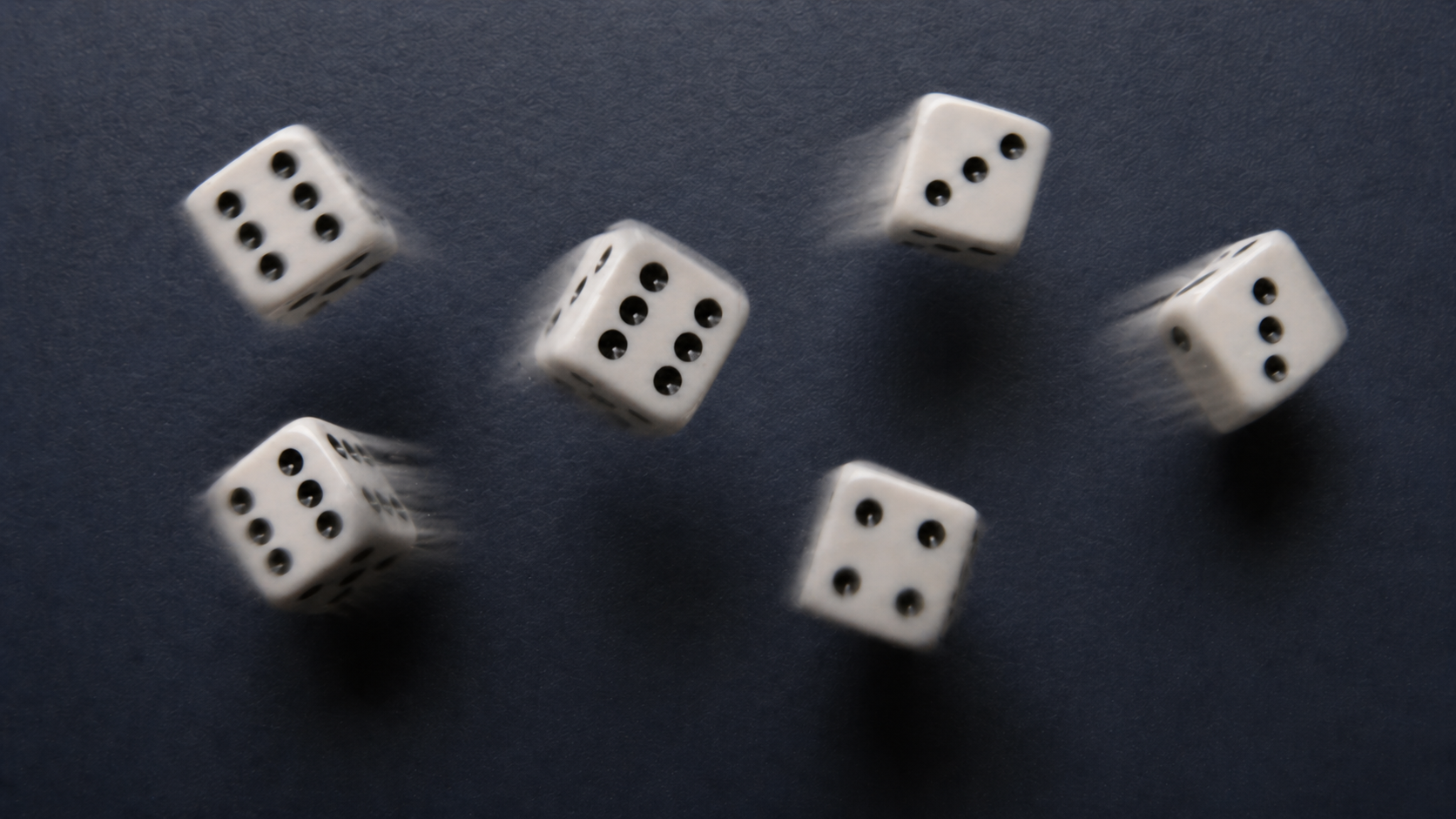
Hod 6 kostek
Každé kolo začínáš hodem 6 kostkami.
Spočítej body
Po hodu zkontroluj, kolik bodů ti padlo.
Musíš získat alespoň nějakou bodovou hodnotu.
Pokud nepadne žádná bodová kombinace, tvoje kolo končí a hraje další hráč.
Pokračování
Hráč si nechal kostku s hodnotou 1, tedy 100 bodů, a hodil znovu 5 kostkami.
Měl štěstí a padly mu další dvě jedničky.
Společně s jedničkou z předchozího hodu má nyní tři jedničky.
Tři jedničky mají hodnotu 1000 bodů.
Prohra
Hráč se rozhodl nechat si tři jedničky za 1000 bodů a házet dál se zbývajícími 3 kostkami.
Padlo mu 3, 4 a 6.
Tyto kostky netvoří žádnou bodovou hodnotu.
To znamená, že hráč ztrácí všechny body, které v tomto kole naházel.
Přichází tedy o tři jedničky za 1000 bodů.
Za toto kolo si zapíše 0 bodů a pokračuje další hráč.
Alternativní situace
Pokud by hráč místo toho padli kostky například 1, 5 a 5, pak jeho výsledná kombinace by byla:
1, 1, 1, 1, 5, 5
To znamená:
2000 + 50 + 50 = 2100 bodů
Hráč využil všech 6 kostek a všechny kostky tvoří bodovou hodnotu.
Díky tomu může znovu házet všemi 6 kostkami.
Body, které v dalším hodu získá, se přičtou k původním 2100 bodům.
Pozor: pokud ale při dalším hodu nepadne žádná bodová hodnota, hráč ztrácí vše.
Přijde tedy i o 2100 bodů z předchozích hodů v tomto kole.
Nechat body, nebo házet dál?
Body, které ti padly, si můžeš nechat a ukončit kolo.
Získané body se ti přičtou k celkovému skóre.
Nebo můžeš pokračovat a házet znovu se zbývajícími kostkami, které nejsou součástí bodové kombinace.
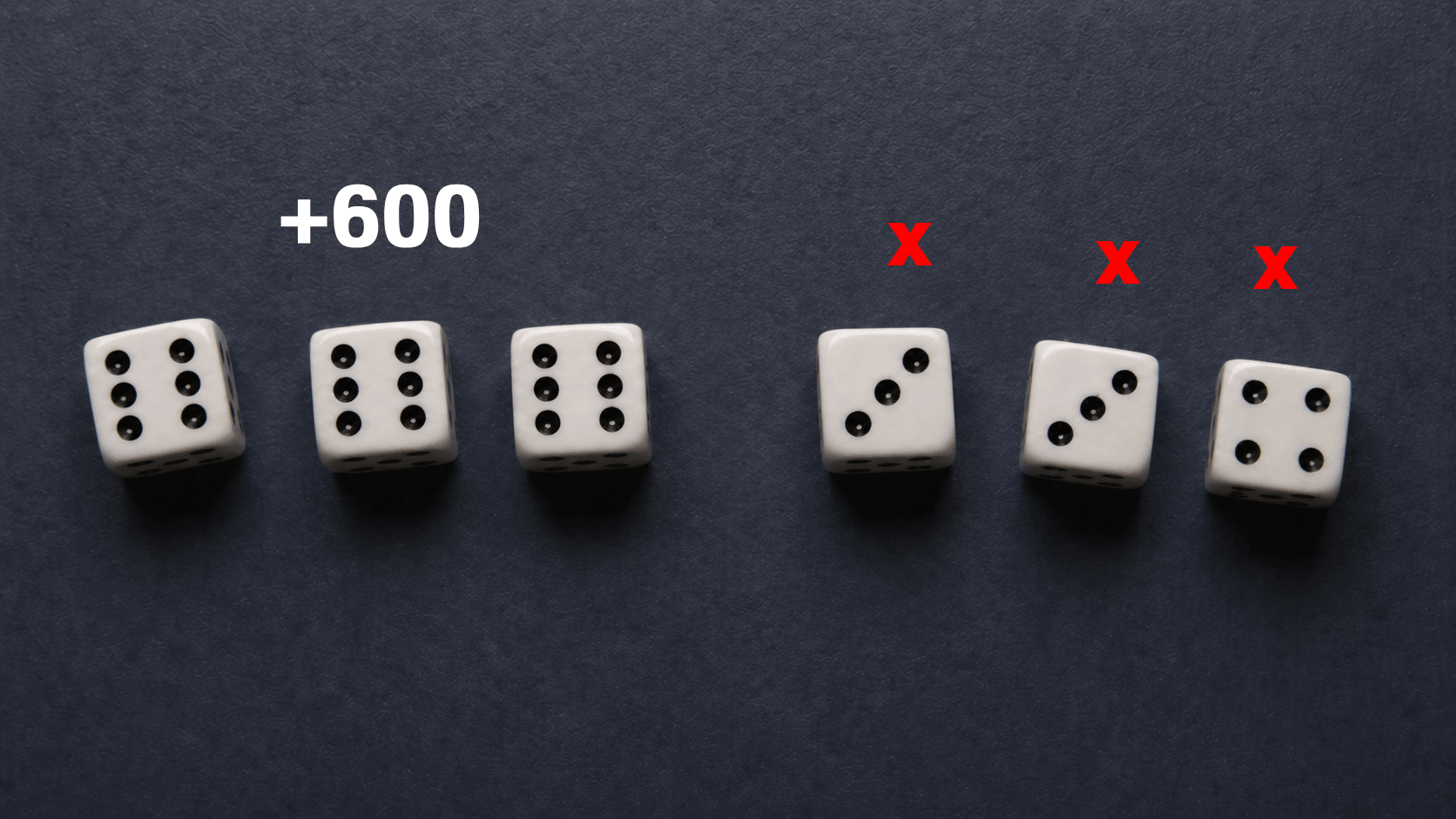
V tomto příkladu hráč hodil 6, 6, 6, tedy 600 bodů.
Teď se musí rozhodnout:
nechá si body zapsat do banku a ukončí kolo, nebo zariskuje a hodí znovu se zbývajícími 3 kostkami?
Pokud bude pokračovat, může získat ještě více bodů.
Zároveň ale riskuje, že pokud nehodí žádnou další bodovou hodnotu, přijde o všechny body naházené v tomto kole.
Příkladový hod
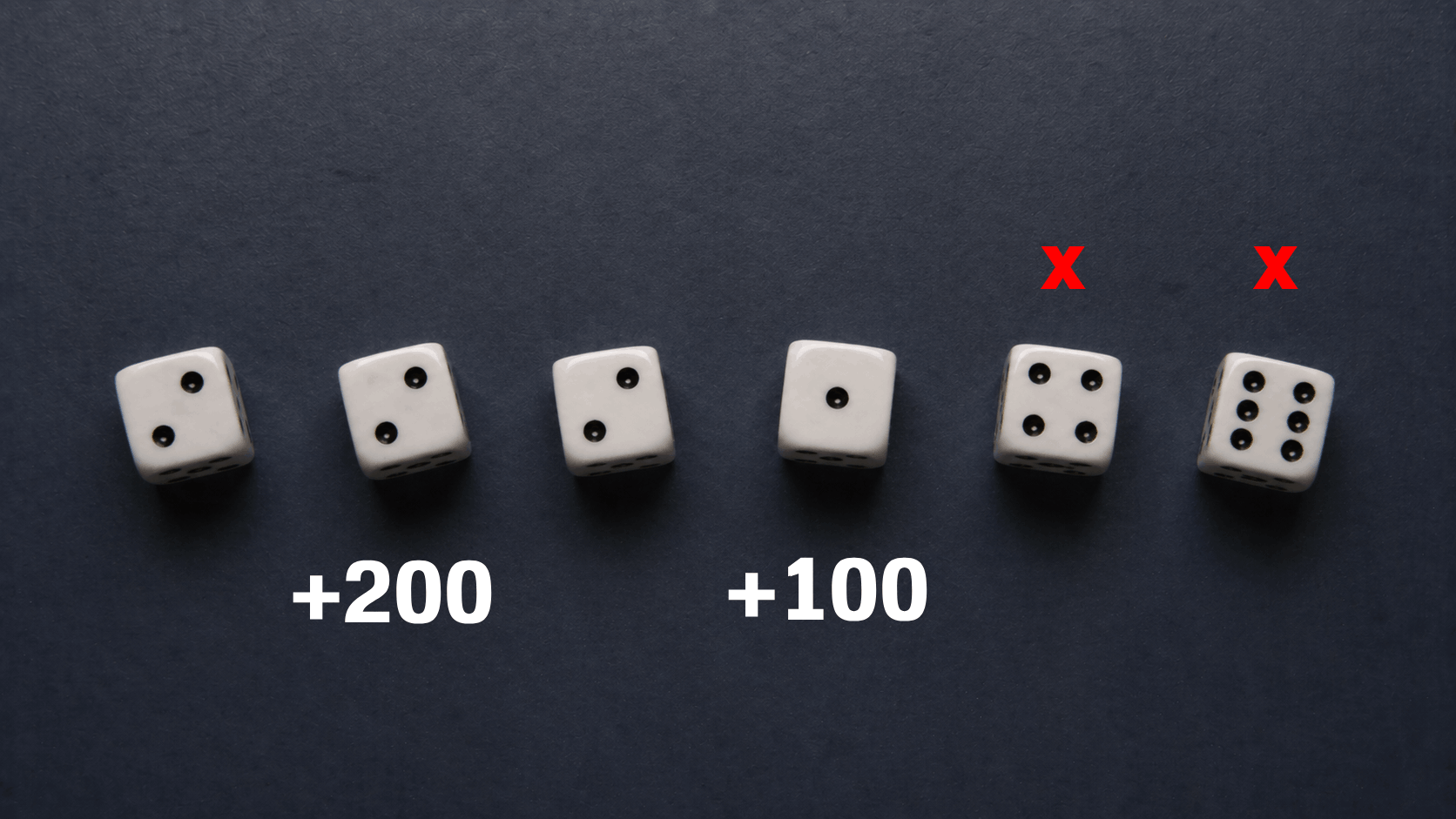
Hráči padla jedna jednička a tři dvojky.
To znamená 100 bodů za jedničku a 200 bodů za tři dvojky.
Hráč si ale může vybrat, co si nechá:
Může si nechat všechny bodující kostky, zapsat si body a ukončit kolo. Poté pokračuje další hráč.
Může si nechat 1, 2, 2, 2, tedy všechny bodující kostky, a házet dál se zbývajícími 2 kostkami. Riskuje ale, že pokud nehodí žádnou další bodovou hodnotu, přijde o všechny body naházené v tomto kole.
Může si nechat pouze jedničku za 100 bodů a znovu házet s 5 kostkami. Doufá tak v lepší výsledek.
Může si také nechat tři dvojky za 200 bodů a pokračovat se 3 zbývajícími kostkami.
Pravidlo je jednoduché: po každém hodu si musíš nechat alespoň jednu bodovou hodnotu.
Co teď?
Hráč má teď několik dobrých možností:
Může si nechat pouze pětku za 50 bodů a házet dál s 5 kostkami.
Může si nechat tři jedničky za 1000 bodů a házet dál se 3 kostkami.
Nebo si může nechat tři jedničky a pětku dohromady za 1050 bodů.
Potom se může rozhodnout dál neházet a uložit si 1050 bodů do svého banku.
Basic Rules of Royal Farkle
Rolling 6 Dice
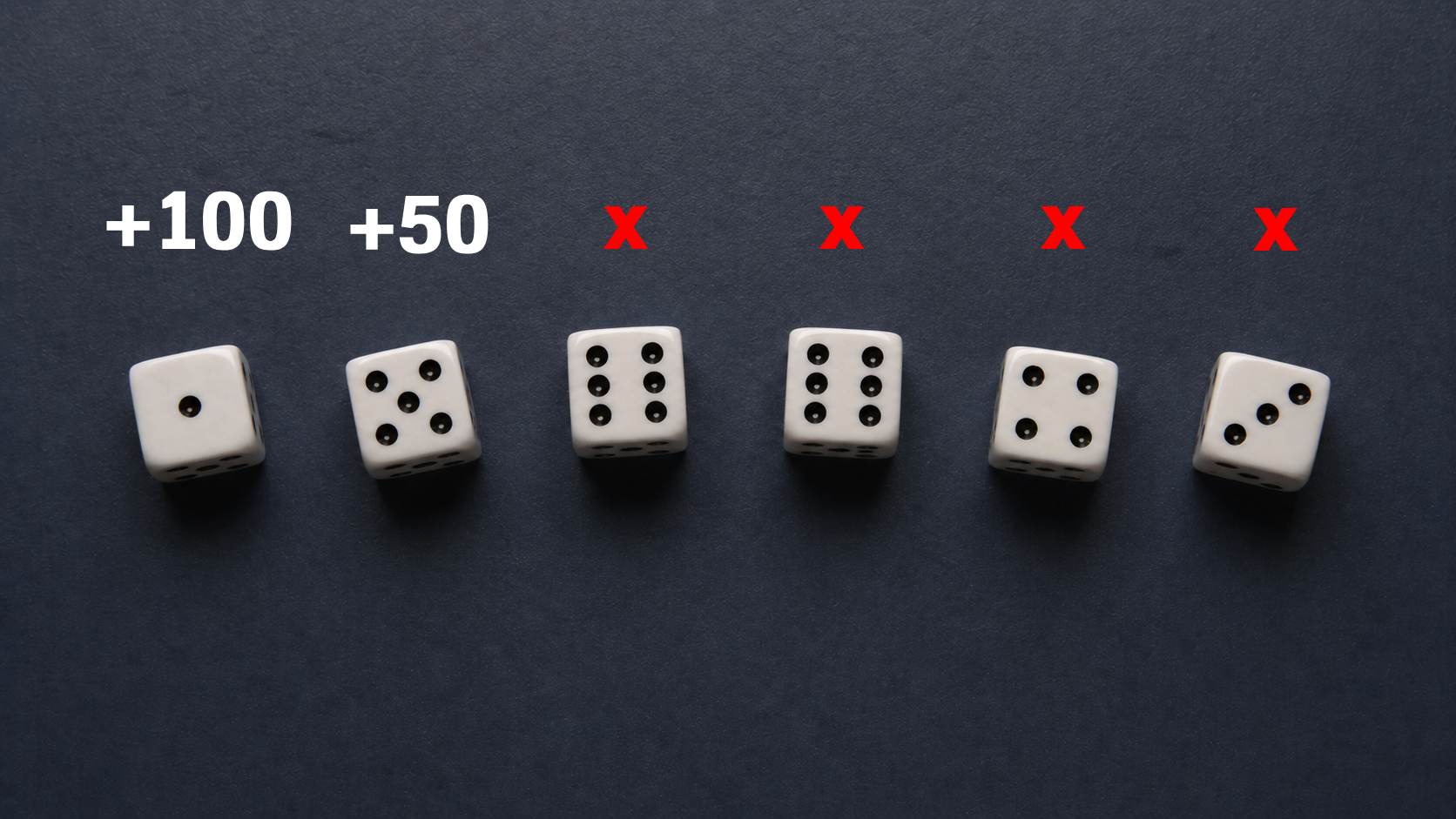
Each turn starts with a roll of 6 dice.
Count the Points
After the roll, check how many points you rolled.
You must roll at least one scoring value.
If no scoring combination is rolled, your turn ends and the next player plays.
Continuing
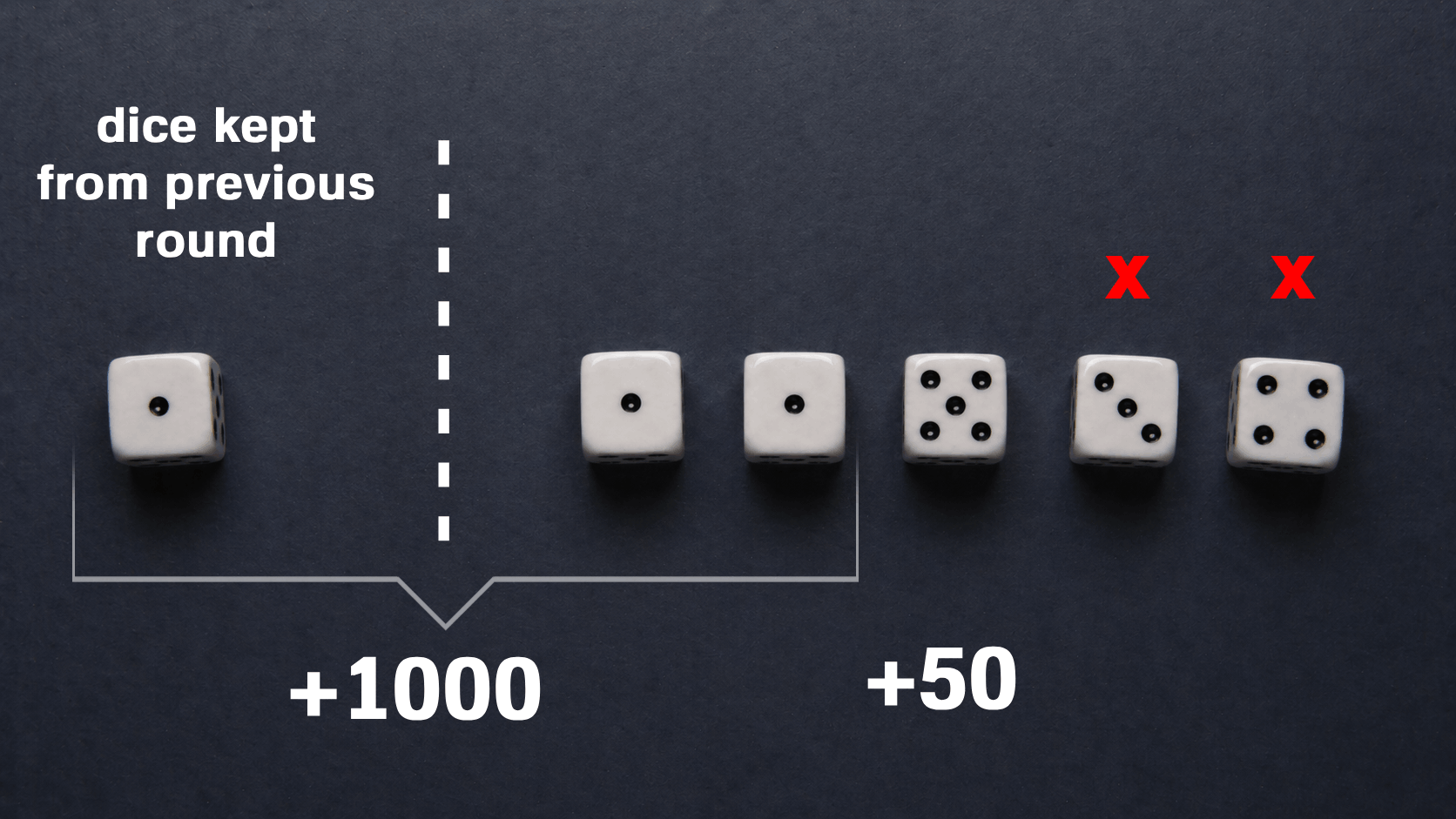
The player kept a die with the value 1, worth 100 points, and rolled again with 5 dice.
They were lucky and rolled two more ones.
Together with the one from the previous roll, they now have three ones.
Three ones are worth 1000 points.
Losing the Turn
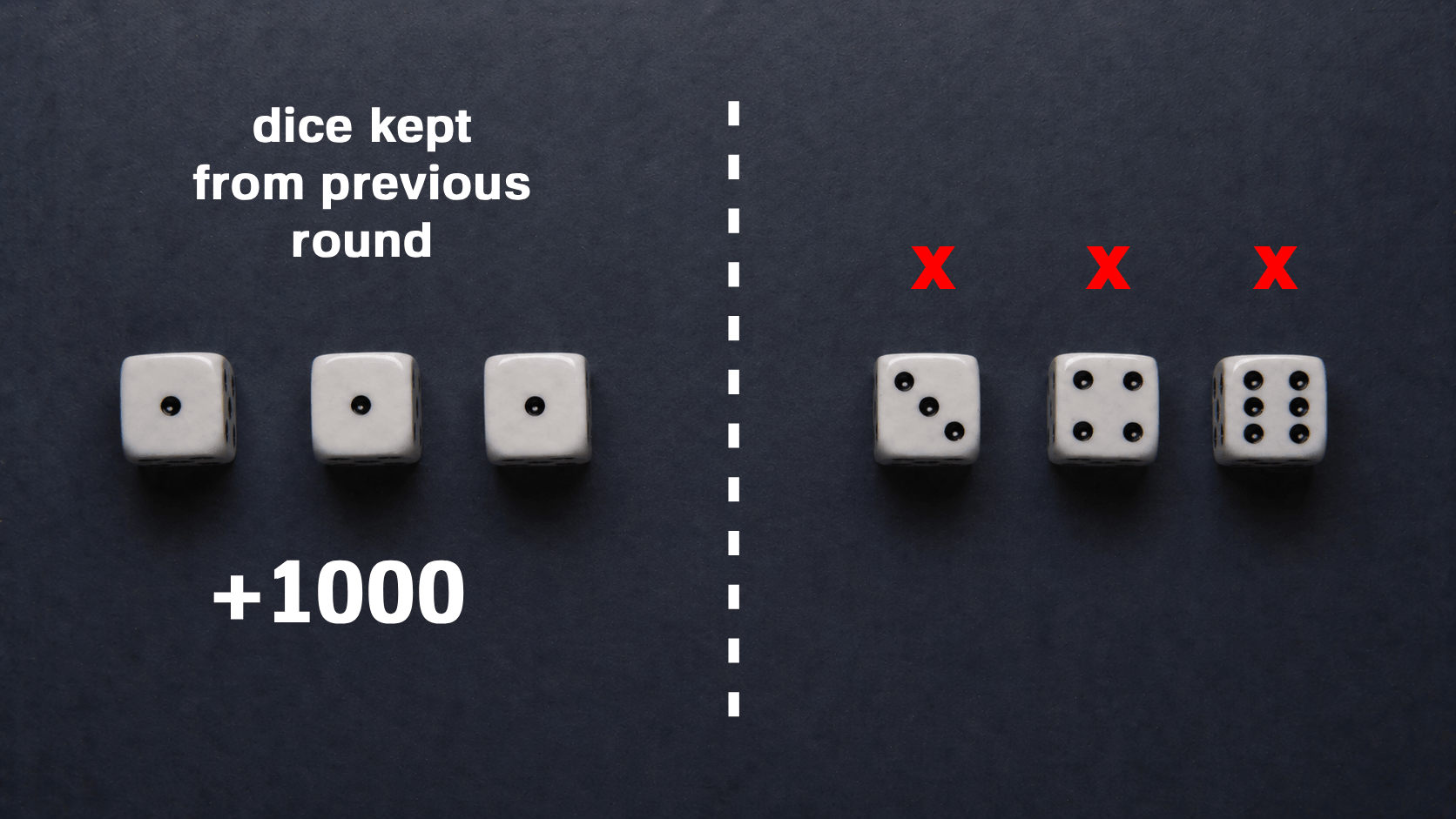
The player decided to keep three ones for 1000 points and continue rolling with the remaining 3 dice.
They rolled 3, 4, and 6.
These dice do not form any scoring value.
That means the player loses all points rolled during this turn.
So they lose the three ones worth 1000 points.
They score 0 points for this turn and the next player continues.
Alternative Situation
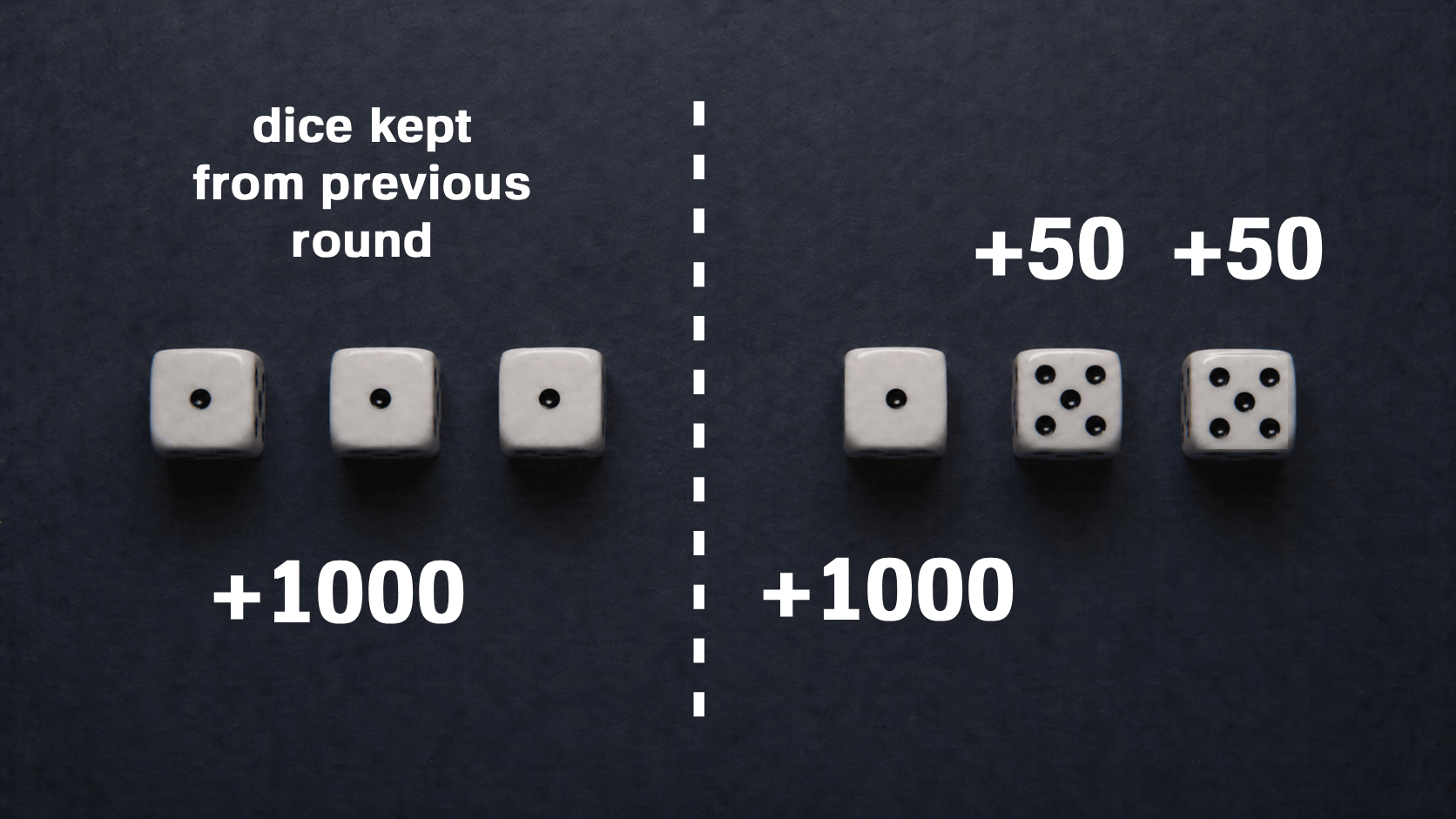
If the player had instead rolled, for example, 1, 5, and 5, their final combination would be:
1, 1, 1, 1, 5, 5
That means:
2000 + 50 + 50 = 2100 points
The player used all 6 dice, and all dice form scoring values.
Because of this, they may roll again with all 6 dice.
Any points they score on the next roll are added to the original 2100 points.
Warning: if no scoring value is rolled on the next roll, the player loses everything.
That means they also lose the 2100 points from the previous rolls in this turn.
Bank the Points or Keep Rolling?
You may keep the points you rolled and end your turn.
The points you earned are added to your total score.
Or you may continue and roll again with the remaining dice that are not part of a scoring combination.
In this example, the player rolled 6, 6, 6, worth 600 points.
Now they must decide:
Should they bank the points and end their turn, or take a risk and roll again with the remaining 3 dice?
If they continue, they may score even more points.
At the same time, they risk losing all points rolled during this turn if they do not roll another scoring value.
Example Roll
The player rolled one one and three twos.
That means 100 points for the one and 200 points for the three twos.
However, the player may choose what to keep:
They may keep all scoring dice, bank the points, and end their turn. Then the next player continues.
They may keep 1, 2, 2, 2 — all scoring dice — and continue rolling with the remaining 2 dice. But they risk losing all points rolled during this turn if they do not roll another scoring value.
They may keep only the one for 100 points and roll again with 5 dice, hoping for a better result.
They may also keep the three twos for 200 points and continue with the 3 remaining dice.
The rule is simple: after every roll, you must keep at least one scoring value.
Grundregeln von Royal Farkle
Wurf mit 6 Würfeln
Jeder Zug beginnt mit einem Wurf von 6 Würfeln.
Punkte zählen
Nach dem Wurf prüfst du, wie viele Punkte du gewürfelt hast.
Du musst mindestens eine wertende Kombination erzielen.
Wenn keine wertende Kombination fällt, endet dein Zug und der nächste Spieler ist an der Reihe.
Weiterspielen
Der Spieler hat einen Würfel mit dem Wert 1 behalten, also 100 Punkte, und erneut mit 5 Würfeln gewürfelt.
Er hatte Glück und würfelte zwei weitere Einsen.
Zusammen mit der Eins aus dem vorherigen Wurf hat er nun drei Einsen.
Drei Einsen sind 1000 Punkte wert.
Zug verloren
Der Spieler entscheidet sich, die drei Einsen für 1000 Punkte zu behalten und mit den übrigen 3 Würfeln weiterzuwürfeln.
Er würfelt 3, 4 und 6.
Diese Würfel bilden keine wertende Kombination.
Das bedeutet, dass der Spieler alle Punkte verliert, die er in diesem Zug erzielt hat.
Er verliert also die drei Einsen im Wert von 1000 Punkten.
Für diesen Zug schreibt er 0 Punkte auf und der nächste Spieler ist an der Reihe.
Alternativsituation
Wenn der Spieler stattdessen zum Beispiel 1, 5 und 5 gewürfelt hätte, wäre seine endgültige Kombination:
1, 1, 1, 1, 5, 5
Das bedeutet:
2000 + 50 + 50 = 2100 Punkte
Der Spieler hat alle 6 Würfel verwendet und alle Würfel bilden wertende Kombinationen.
Dadurch darf er erneut mit allen 6 Würfeln würfeln.
Die Punkte, die er beim nächsten Wurf erzielt, werden zu den ursprünglichen 2100 Punkten addiert.
Achtung: Wenn beim nächsten Wurf keine wertende Kombination fällt, verliert der Spieler alles.
Er verliert also auch die 2100 Punkte aus den vorherigen Würfen in diesem Zug.
Punkte sichern oder weiterwürfeln?
Du kannst die gewürfelten Punkte behalten und deinen Zug beenden.
Die erzielten Punkte werden zu deinem Gesamtergebnis addiert.
Oder du kannst weitermachen und erneut mit den übrigen Würfeln würfeln, die nicht Teil einer wertenden Kombination sind.
In diesem Beispiel hat der Spieler 6, 6, 6 gewürfelt, also 600 Punkte.
Jetzt muss er sich entscheiden:
Sichert er die Punkte auf seinem Punktekonto und beendet den Zug, oder riskiert er es und würfelt erneut mit den übrigen 3 Würfeln?
Wenn er weitermacht, kann er noch mehr Punkte erzielen.
Gleichzeitig riskiert er aber, alle Punkte aus diesem Zug zu verlieren, falls er keine weitere wertende Kombination würfelt.
Beispielwurf
Der Spieler hat eine Eins und drei Zweien gewürfelt.
Das bedeutet 100 Punkte für die Eins und 200 Punkte für die drei Zweien.
Der Spieler kann jedoch wählen, was er behalten möchte:
Er kann alle wertenden Würfel behalten, die Punkte sichern und seinen Zug beenden. Danach ist der nächste Spieler an der Reihe.
Er kann 1, 2, 2, 2 behalten, also alle wertenden Würfel, und mit den übrigen 2 Würfeln weiterwürfeln. Dabei riskiert er aber, alle Punkte aus diesem Zug zu verlieren, falls er keine weitere wertende Kombination würfelt.
Er kann nur die Eins für 100 Punkte behalten und erneut mit 5 Würfeln würfeln, in der Hoffnung auf ein besseres Ergebnis.
Er kann auch die drei Zweien für 200 Punkte behalten und mit den 3 übrigen Würfeln weitermachen.
Die Regel ist einfach: Nach jedem Wurf musst du mindestens eine wertende Kombination behalten.
Règles de base du jeu Royal Farkle
Lancer de 6 dés
Chaque tour commence par un lancer de 6 dés.
Compter les points
Après le lancer, vérifie combien de points tu as obtenus.
Tu dois obtenir au moins une valeur rapportant des points.
Si aucune combinaison rapportant des points n'est obtenue, ton tour se termine et c'est au joueur suivant de jouer.
Continuer
Le joueur a gardé un dé avec la valeur 1, soit 100 points, puis a relancé les 5 dés restants.
Il a eu de la chance et a obtenu deux autres 1.
Avec le 1 du lancer précédent, il possède maintenant trois 1.
Trois 1 valent 1000 points.
Perdre le tour
Le joueur a décidé de garder les trois 1 pour 1000 points et de continuer à lancer avec les 3 dés restants.
Il a obtenu 3, 4 et 6.
Ces dés ne forment aucune valeur rapportant des points.
Cela signifie que le joueur perd tous les points obtenus pendant ce tour.
Il perd donc les trois 1 valant 1000 points.
Il marque 0 point pour ce tour et c'est au joueur suivant de jouer.
Situation alternative
Si le joueur avait obtenu à la place, par exemple, 1, 5 et 5, sa combinaison finale aurait été :
1, 1, 1, 1, 5, 5
Cela signifie :
2000 + 50 + 50 = 2100 points
Le joueur a utilisé les 6 dés et tous les dés rapportent des points.
Grâce à cela, il peut relancer les 6 dés.
Les points qu'il obtiendra lors du lancer suivant seront ajoutés aux 2100 points initiaux.
Attention : si, lors du lancer suivant, aucune valeur rapportant des points n'est obtenue, le joueur perd tout.
Il perd donc aussi les 2100 points des lancers précédents de ce tour.
Garder les points ou continuer à lancer ?
Tu peux garder les points obtenus et terminer ton tour.
Les points gagnés sont ajoutés à ton score total.
Ou tu peux continuer et relancer les dés restants qui ne font pas partie d'une combinaison rapportant des points.
Dans cet exemple, le joueur a lancé 6, 6, 6, soit 600 points.
Il doit maintenant décider :
va-t-il mettre ses points en banque et terminer son tour, ou prendre le risque de relancer les 3 dés restants ?
S'il continue, il peut gagner encore plus de points.
Mais il risque aussi de perdre tous les points obtenus pendant ce tour s'il ne lance aucune nouvelle valeur rapportant des points.
Exemple de lancer
Le joueur a obtenu un 1 et trois 2.
Cela signifie 100 points pour le 1 et 200 points pour les trois 2.
Mais le joueur peut choisir ce qu'il garde :
Il peut garder tous les dés rapportant des points, mettre ses points en banque et terminer son tour. Ensuite, c'est au joueur suivant de jouer.
Il peut garder 1, 2, 2, 2, c'est-à-dire tous les dés rapportant des points, et continuer à lancer avec les 2 dés restants. Mais il risque de perdre tous les points obtenus pendant ce tour s'il ne lance aucune nouvelle valeur rapportant des points.
Il peut garder seulement le 1 pour 100 points et relancer avec 5 dés, en espérant un meilleur résultat.
Il peut aussi garder les trois 2 pour 200 points et continuer avec les 3 dés restants.
La règle est simple : après chaque lancer, tu dois garder au moins une valeur rapportant des points.
Reglas básicas del juego Royal Farkle
Lanzamiento de 6 dados
Cada turno empieza con un lanzamiento de 6 dados.
Contar los puntos
Después del lanzamiento, comprueba cuántos puntos has obtenido.
Debes conseguir al menos algún valor que dé puntos.
Si no sale ninguna combinación que dé puntos, tu turno termina y juega el siguiente jugador.
Continuar
El jugador se quedó con un dado de valor 1, es decir, 100 puntos, y volvió a lanzar con 5 dados.
Tuvo suerte y obtuvo dos unos más.
Junto con el uno del lanzamiento anterior, ahora tiene tres unos.
Tres unos valen 1000 puntos.
Perder el turno
El jugador decidió quedarse con los tres unos por 1000 puntos y seguir lanzando con los 3 dados restantes.
Obtuvo 3, 4 y 6.
Estos dados no forman ningún valor que dé puntos.
Eso significa que el jugador pierde todos los puntos que había conseguido durante este turno.
Por lo tanto, pierde los tres unos por valor de 1000 puntos.
En este turno anota 0 puntos y continúa el siguiente jugador.
Situación alternativa
Si el jugador hubiera obtenido en su lugar, por ejemplo, 1, 5 y 5, su combinación final habría sido:
1, 1, 1, 1, 5, 5
Eso significa:
2000 + 50 + 50 = 2100 puntos
El jugador ha usado los 6 dados y todos los dados forman valores que dan puntos.
Gracias a eso, puede volver a lanzar los 6 dados.
Los puntos que obtenga en el siguiente lanzamiento se sumarán a los 2100 puntos originales.
Atención: si en el siguiente lanzamiento no obtiene ninguna puntuación, el jugador lo pierde todo.
Eso significa que también pierde los 2100 puntos de los lanzamientos anteriores de este turno.
¿Guardar los puntos o seguir lanzando?
Puedes quedarte con los puntos obtenidos y terminar tu turno.
Los puntos ganados se suman a tu puntuación total.
O puedes continuar y volver a lanzar los dados restantes que no forman parte de una combinación que dé puntos.
En este ejemplo, el jugador obtuvo 6, 6, 6, es decir, 600 puntos.
Ahora debe decidir:
¿guardará los puntos en el banco y terminará su turno, o arriesgará y volverá a lanzar los 3 dados restantes?
Si continúa, puede conseguir aún más puntos.
Pero al mismo tiempo corre el riesgo de perder todos los puntos obtenidos durante este turno si no obtiene ningún nuevo valor que dé puntos.
Lanzamiento de ejemplo
Al jugador le salió un uno y tres doses.
Eso significa 100 puntos por el uno y 200 puntos por los tres doses.
Pero el jugador puede elegir qué quedarse:
Puede quedarse con todos los dados que dan puntos, guardar los puntos en el banco y terminar su turno. Después continúa el siguiente jugador.
Puede quedarse con 1, 2, 2, 2, es decir, todos los dados que dan puntos, y seguir lanzando con los 2 dados restantes. Pero corre el riesgo de perder todos los puntos obtenidos durante este turno si no obtiene ningún nuevo valor que dé puntos.
Puede quedarse solo con el uno por 100 puntos y volver a lanzar con 5 dados, esperando conseguir un mejor resultado.
También puede quedarse con los tres doses por 200 puntos y continuar con los 3 dados restantes.
La regla es sencilla: después de cada lanzamiento, debes quedarte con al menos un valor que dé puntos.








 Tournament
 Average Statistics
 Graph History